Insights
Commercial judgement, in practice.
Articles
B2B · 6 November 2026
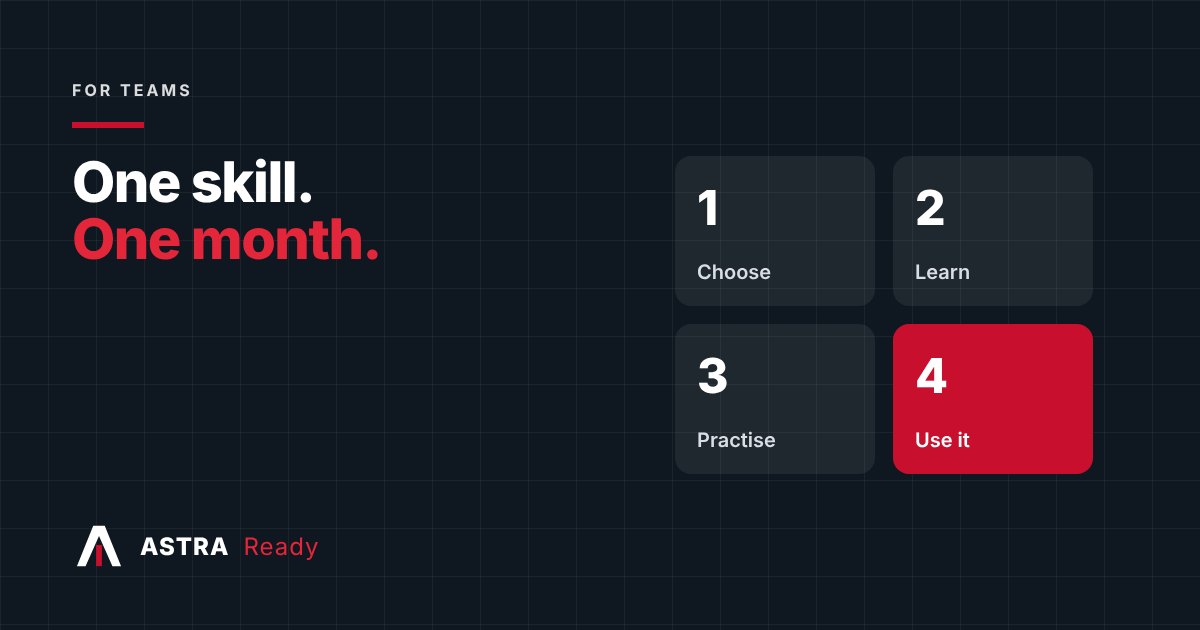
How to build one selling skill across a team in a month
Sales leaders rarely need a whole new curriculum. They need one conversation done better by everyone, fast. A four-week plan using short courses, role-plays and the deals already in your pipeline.

Colleges · 6 November 2026
What a role-play with an AI customer can and cannot show
AI-customer role-plays let learners rehearse discovery, objections and next steps as often as they need. They show habits under pressure. They do not show performance in a real job.
Individuals · 5 November 2026
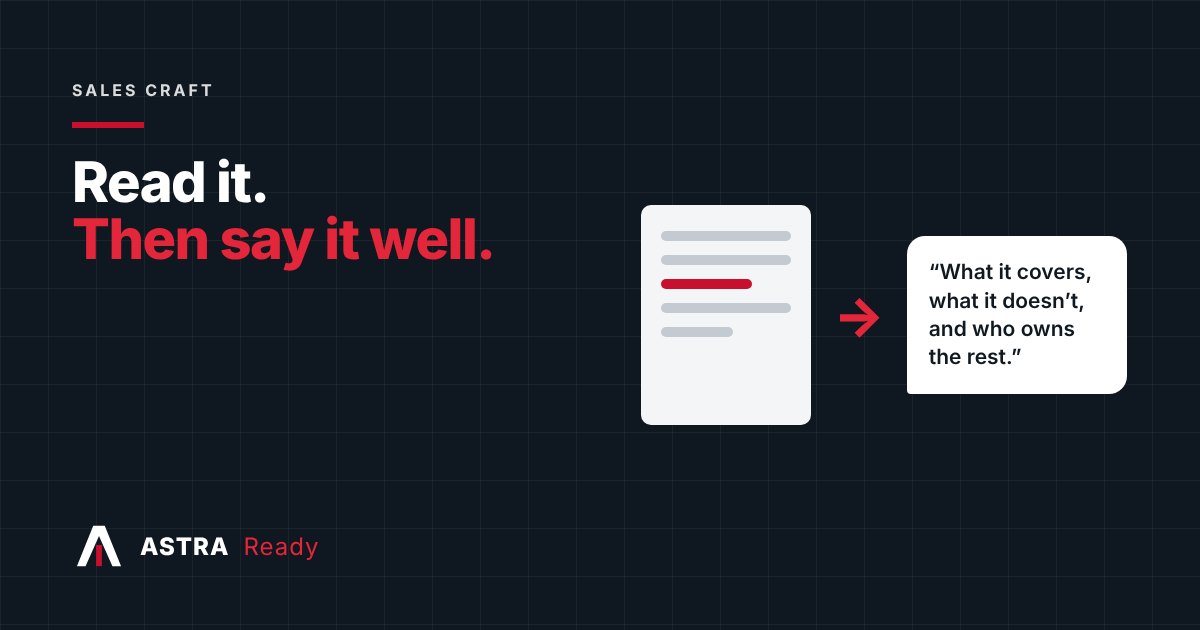
Reading the evidence is half the job. Saying it well is the other half.
Knowing what a proposal proves is not enough on its own. Sellers also have to ask, explain, answer the objection and agree a next step without promising more than the evidence supports. Here is how ASTRA now teaches and tests both.
Individuals · 5 November 2026
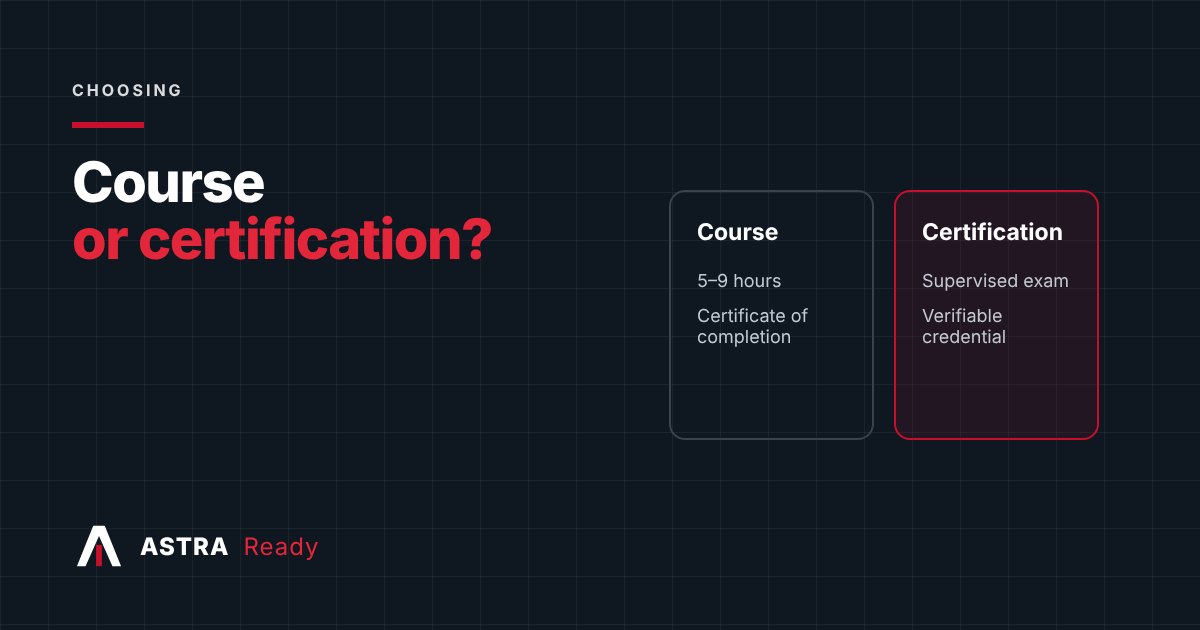
Course or certification: which one do you need?
A short course builds one skill and ends in a certificate of completion. A certification programme ends in a supervised exam and a credential an employer can verify. Here is how to choose.

Individuals · 2 November 2026
Credential validity and renewal: what they mean for sales professionals
Credential validity is an issuer policy, not a lifetime promise of skill. Sales professionals should understand expiry, renewal, standards and how employers interpret older achievements.

Individuals · 2 November 2026
Modern digital credentials can carry issuer, criteria, recipient and evidence metadata
Open Badges 3.0 shows how digital credentials can carry more than an image, giving employers information about the issuer, recipient, criteria and achievement evidence.

Individuals · 1 November 2026
Training provider versus certification issuer: what buyers should check
Training delivery and certification issuance are different functions. Buyers should check who teaches, who sets the assessment, who decides results and who can verify credentials.

Individuals · 1 November 2026
A digital credential identifies the issuer making the achievement claim
Open Badges treats the issuer as the organisation making an achievement claim, a distinction when training is delivered by a partner but certification remains controlled.

Individuals · 31 October 2026
What makes a sales credential credible to employers?
Employers should judge a sales credential by its issuer, assessment, verification, validity and bounded claim. A badge matters less than transparent evidence behind the achievement.

Individuals · 31 October 2026
Half of the surveyed workforce had completed training in long-term learning strategies
The World Economic Forum reports participation in long-term workforce training, reinforcing that credentials work best when they sit inside continuous development rather than replace it.

Individuals · 30 October 2026
What is a staged case exam?
A staged case releases evidence in steps, testing whether candidates update decisions without using information that was unavailable. Preparation is about sequencing, not guessing ahead.

Individuals · 30 October 2026
Credential verification is not the same as judging whether a credential fits a job
Digital credential standards separate authenticity from relevance, giving employers a rule: first verify the credential, then decide whether its assessed claim matters to the role.

Individuals · 29 October 2026
How to prepare for a case-based tech sales certification exam
Case-based exams test decisions from supplied evidence rather than memorised phrases. Preparation should focus on reading boundaries, calculating, identifying owners and explaining why alternatives fail.

Individuals · 29 October 2026
Home exam check-in can include identity photos and a room scan
Online supervised exams can require identity and workspace checks before launch, so candidates should test devices, prepare the room and read provider rules early carefully.

Individuals · 28 October 2026
What certification is useful for a pre-sales career?
Pre-sales combines technical translation, customer discovery and solution validation. The right credential depends on whether your gap is product depth, architecture skill or commercial judgement.

Individuals · 28 October 2026
Sales engineering combines technical knowledge with customer-facing selling
Public occupational guidance describes sales engineering as a mix of technical expertise and customer communication, explaining why pre-sales development often needs both commercial credentials.

Individuals · 27 October 2026
Do you need a certification for tech sales?
A tech sales credential is rarely a universal requirement. Its value depends on what was assessed, your role, evidence and the capability gap you need.

Individuals · 27 October 2026
39% of workers’ core skills are expected to change by 2030
Employers expect substantial skill change by 2030, useful context for tech sellers deciding whether ongoing learning and assessment should remain part of their career plan.

Individuals · 26 October 2026
How to use breach-cost statistics without fear selling
Breach-cost studies show why cybersecurity matters but cannot predict one customer’s loss. Sellers should use public statistics as context, then return to customer-specific evidence.

Individuals · 26 October 2026
IBM reported an INR 255 million average breach cost in India for 2026
IBM’s India breach study reported a higher average organisational cost in 2026, useful context only if sellers avoid turning sample averages into customer-specific loss estimates.

Individuals · 25 October 2026
What an SBOM tells a buyer — and what it does not
A software bill of materials improves component transparency but does not prove security. Sellers should explain provenance, scope, updates and decisions SBOM data can support.

Individuals · 25 October 2026
An SBOM is a component record, not proof that software is secure
International SBOM guidance describes component transparency, giving sellers a precise boundary: it helps show what is present in a product, not whether software is secure.

Individuals · 24 October 2026
Secure by design for sellers: what changes in a product conversation
Secure by design shifts attention towards manufacturer responsibility, safer defaults and transparency. Sellers should explain product evidence precisely rather than pushing security responsibility onto customers.

Individuals · 24 October 2026
CISA’s secure-by-design framing centres on three manufacturer principles
CISA’s secure-by-design guidance emphasises customer security outcomes, transparency and accountability, giving sellers a framework for explaining default protections and product responsibility without shifting everything downstream.

Partners · 24 October 2026
When your sellers repeat a vendor claim, who carries the gap?
A datasheet says 24/7. A certificate covers a different product. An AI promise applies only to one plan. When a partner seller repeats a vendor claim, the gap becomes theirs. Here is how to spot it, who should check it and what to say instead.

Individuals · 23 October 2026
Cloud data security for sellers: visibility matters before the control conversation
Cloud data-security discussions improve when sellers separate visibility, tooling, ownership and customer configuration instead of treating a security platform as proof that risk is controlled.

Individuals · 23 October 2026
54% of one cloud-security survey used four or more data-risk tools
Cloud Security Alliance survey data shows tool sprawl in data-risk management, useful context because more dashboards do not automatically create better visibility or stronger prioritisation.

Individuals · 22 October 2026
Geopolitics and cyber buying: what a seller should not assume
Geopolitical risk is entering cybersecurity strategy, but sellers should not turn regional headlines into customer requirements. Start with the buyer’s exposure, architecture and decision owners.

Individuals · 22 October 2026
64% of surveyed organisations were accounting for geopolitically motivated cyberattacks
World Economic Forum data shows geopolitical risk entering cybersecurity strategy, useful context for sellers when they return quickly to each buyer’s actual dependencies and evidence.

Individuals · 21 October 2026
Cyber-enabled fraud is changing the security conversation
Cyber-enabled fraud is now a board-level concern. Sellers should connect customer evidence, identity, process and operating ownership without turning rising risk into fear-based selling today.

Individuals · 21 October 2026
73% of cybersecurity leaders surveyed had fraud touch their network
The World Economic Forum found cyber-enabled fraud touching many respondents personally, useful context for sellers because fraud conversations cross identity, security, finance and customer operations.

Individuals · 20 October 2026
Zero trust for sellers: what it means and what it does not
Zero trust is an access and architecture approach, not a magic security outcome. Sellers need to explain resource protection, identity checks and customer responsibilities precisely.

Individuals · 20 October 2026
Zero trust does not grant trust from network location alone
NIST’s zero-trust model removes automatic trust based on network location or ownership, giving sellers a clearer way to discuss identity, policy and resource access decisions.

Individuals · 19 October 2026
Moving from tech sales into cybersecurity sales: what transfers and what you still need to learn
Experienced tech sellers bring discovery and commercial skills. Moving into cybersecurity sales adds security evidence, technical boundaries and buyer-risk conversations that require deliberate specialist learning.

Individuals · 19 October 2026
63% of surveyed Indian enterprises reported limited hands-on cybersecurity skills among candidates
India’s 2026 cybersecurity-skilling report points to a practical capability gap, useful context for sellers moving into security because specialist credibility needs more than memorised terminology.

Individuals · 18 October 2026
Security procurement is part of the sale: how to prepare before the questionnaire arrives
Security procurement can introduce evidence, contracting and product-security questions late. Sellers reduce friction by mapping requirements, owners and proof before the formal review begins.

Individuals · 18 October 2026
CISA’s Secure by Demand guide puts product security into the buying process
CISA’s buyer guidance treats product security as a procurement consideration, reminding cybersecurity sellers that evidence and product-security questions belong inside the commercial process before purchase.

Individuals · 17 October 2026
Cloud economics for sellers: what FinOps changes in discovery
Cloud buyers increasingly manage usage, allocation, forecasting and value together. Sellers who understand FinOps ask better questions about meters, ownership, commitments and bill drivers.

Individuals · 17 October 2026
63% of State of FinOps respondents were managing AI spending in 2025
The State of FinOps 2025 found AI spending moving into mainstream cost management, giving sellers reason to discuss usage, allocation and forecasting before claiming value.

Individuals · 16 October 2026
How to discuss AI with enterprise buyers without turning model output into evidence
AI can strengthen sales workflows, but buyer claims still need evidence. Sellers should separate generated language, observed performance, operating controls and decisions that remain unproven.

Individuals · 16 October 2026
NIST’s generative-AI profile organises 13 risks and more than 400 actions
NIST’s generative-AI profile shows how broad AI risk management can become, so sellers should treat AI answers as drafts and keep customer claims commercially evidence-bound.

Individuals · 15 October 2026
Customer success in tech: what happens after the sale
Customer success begins after signature but stays commercial. The role connects onboarding, adoption, value evidence, renewal risk and expansion without turning relationships into unsupported promises.

Individuals · 15 October 2026
Security Management Specialists are among the fastest-growing roles in the World Economic Forum outlook
World Economic Forum places Security Management Specialists among fast-growing roles globally, useful context because security buying increasingly involves specialist stakeholders and evidence-heavy decisions.

Individuals · 14 October 2026
Sales versus pre-sales: where ownership changes in a complex tech deal
Sales and pre-sales work on the same customer decision from different angles. Clear ownership prevents technical evidence, commercial commitments and customer expectations from becoming blurred.

Individuals · 14 October 2026
The World Economic Forum expects major job creation and displacement by 2030
World Economic Forum projections show job creation and displacement through 2030, reminding sales professionals to build adaptable commercial and technology judgment instead of chasing titles.

Individuals · 13 October 2026
Channel careers in APAC: what the job really involves
Channel roles mix partner recruitment, enablement, pipeline work and customer selling. The strongest candidates understand commercial authority, partner economics and how deals move across organisations.

Individuals · 13 October 2026
Business-development roles remain relevant as technology and trade conditions change
World Economic Forum links business-development demand to changing trade and technology conditions, useful context for channel professionals whose work combines partner strategy with commercial execution.

Individuals · 12 October 2026
What hiring managers test in a tech-sales interview
Tech-sales interviews test more than confidence. Candidates need evidence of prospecting, discovery, commercial judgment, technical collaboration and clear customer communication across real selling situations today.

Individuals · 12 October 2026
Indian SDR salary data spans a very wide range
Public salary data for Indian Sales Development Representatives spans a broad range, showing why candidates should compare experience, fixed pay, variable pay and quota together.

Individuals · 11 October 2026
India incident-reporting rules: the facts a cybersecurity seller should know
India’s incident-reporting landscape has dated rules and phased privacy-law commencement. Sellers should know the published facts, avoid legal interpretation and route customer questions correctly.

Individuals · 11 October 2026
The DPDP Rules use phased commencement, not one start date
The notified DPDP Rules split commencement across publication, one-year and eighteen-month points, so sellers should quote Gazette timelines rather than compressing them into one date.

Individuals · 10 October 2026
How to read an assurance report when you are the seller
An assurance report can support a sales claim only within its scope. Sellers should check service coverage, period, criteria, exceptions and customer responsibilities before answering.

Individuals · 10 October 2026
CERT-In’s incident-reporting direction uses a six-hour clock
CERT-In’s 2022 directions specify a six-hour reporting window for listed incidents, a fact sellers should state accurately while leaving applicability decisions to authorised owners.

Individuals · 9 October 2026
What is a proof of concept, and why should a seller care?
A proof of concept is not a long demo. Sellers should define the customer question, success evidence, operating boundary, owners and next decision before starting.

Individuals · 9 October 2026
Only 5.9% of one 2026 India tech-job sample was entry-level
A mid-2026 job-posting analysis found relatively few entry-level technology roles, a useful reminder that new sellers need demonstrable capability rather than relying on title alone.

Individuals · 8 October 2026
How security buying decisions are really made
Security deals move through risk, technical, commercial and governance decisions. Sellers progress faster when they identify each decision, owner, evidence and unresolved gate early.

Individuals · 8 October 2026
Cybersecurity employers report persistent difficulty finding skilled candidates
A 2026 India cybersecurity-skilling study found candidate shortages and long hiring cycles, reinforcing why commercial roles benefit from credible security understanding without pretending engineering expertise.

Individuals · 7 October 2026
Is cybersecurity sales a lucrative career in India? What the evidence says
Cybersecurity sales can reward specialist knowledge, but current Indian evidence shows wide pay ranges, demanding roles and a market where buyer trust matters greatly.

Individuals · 7 October 2026
India information-security spending is forecast to grow 11.7% in 2026
India’s security-spending forecast points to a growing market, but sellers should translate investment into customer priorities rather than treating market growth as automatic demand.

Individuals · 6 October 2026
Is tech sales a lucrative career in India? What the numbers say
Public data shows wide salary ranges in Indian tech sales; role, experience, city and variable pay matter more than any single headline number today.

Individuals · 6 October 2026
India’s tech sector added a six-figure number of net jobs
India’s technology sector remained a major employer in FY2026, but the headline job number is industry-wide and should not be mistaken for tech-sales hiring.

Resource · 4 October 2026
50 prompts for tech and cybersecurity sellers (GPT and Claude)
Fifty evidence-bound prompts help tech and cybersecurity sellers use GPT or Claude for discovery, translation, proof, commercial review and customer-ready writing without inventing facts.

Individuals · 3 October 2026
Product fluency gets you into the meeting. Judgement keeps the deal credible.
Why cloud, security and AI sellers need commercial judgement as well as product knowledge in complex customer conversations.

Colleges · 3 October 2026
The interview panel stopped asking for buzzwords and asked for a decision.
How colleges can help students explain technology decisions with evidence, ownership and commercial context in interviews.

Individuals · 3 October 2026
The customer asked for proof. Confidence was not enough.
A practical approach to answering hard cloud, security and AI customer questions without bluffing or overclaiming.

B2B · 3 October 2026
One customer question exposed five different answers inside the team.
How sales, pre-sales, customer success and partner teams can align on evidence, ownership and customer decisions.

B2B · 3 October 2026
The deal was signed. The real risk appeared in the handover.
Why deal handovers fail in cloud, security and AI sales, and how to transfer evidence, owners and open gates clearly.

Colleges · 3 October 2026
Put the business student and the engineer on the same customer case.
A practical way for colleges to bring business and engineering students together around cloud, security and AI decisions.